1 / 19
6.5/10Rating
Other ratings
kino.is—
IMDb6.4
1 700 оценокLetterboxd3.2/5
846 оценокTMDB6.2
29 оценокRT — зрители66%
RT — критики67%
Trakt70%
29 KP6.9
273 оценокFriends—
🔥1
Production

Description
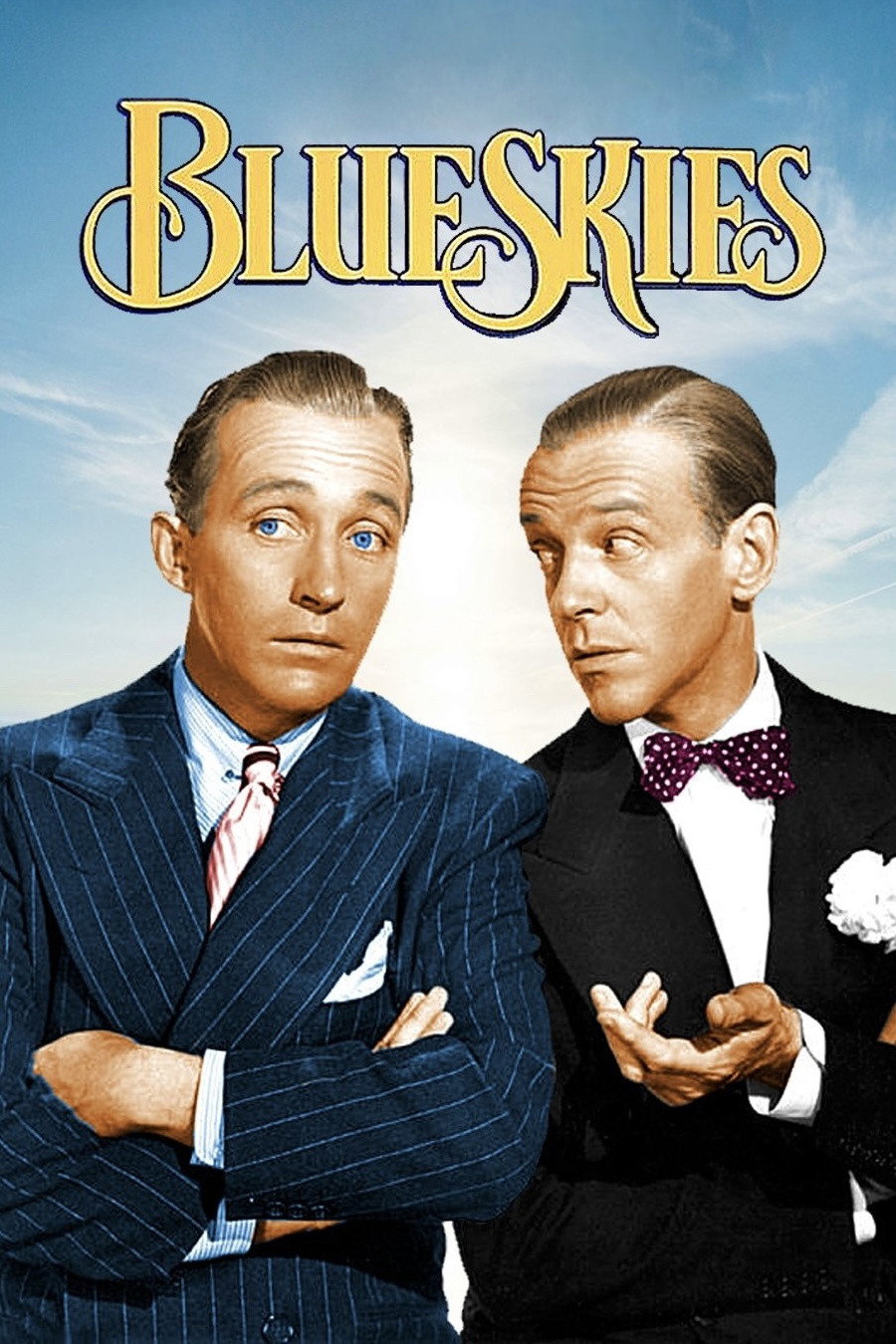
Blue Skies is a 1946 American musical romantic comedy film directed by Stuart Heisler and starring Bing Crosby, Fred Astaire, and Joan Caulfield. Based on a story by Irving Berlin, the film is about a dancer who loves a chorus girl, who in turn loves a compulsive nightclub-opener who cannot stay committed to anything in life for very long. Produced by Sol C. Siegel, Blue Skies was filmed in Technicolor and released by Paramount Pictures. The music, lyrics, and story were written by Berlin, with most of the songs recycled from earlier works.
As in Holiday Inn (1942), the film is designed to showcase Berlin's songs. The plot, which is presented in a series of flashbacks with Astaire as narrator, follows a similar formula of Crosby beating Astaire for the affections of a leading lady. Comedy is principally provided by Billy De Wolfe, and several musical numbers are performed by Olga San Juan.
Caulfield was the protégé of Mark Sandrich, who directed many of the Astaire–Ginger Rogers musicals. Sandrich was originally slated to direct this film, but died of a heart attack during pre-production and Stuart Heisler was drafted in to replace him. Heisler wanted Caulfield replaced, but Crosby—who was having an affair with Caulfield—protected her.
Tap dancer Paul Draper was the initial choice to partner Crosby, but, during the first week of production, Draper's speech impediment and his trenchant criticism of Caulfield's dance ability led Crosby to insist on his replacement by Astaire, who, then 47, decided that this would be his final film and that he would subsequently retire, having spent over 40 years performing before the public. The film was billed as "Astaire's last picture" and its very strong performance at the box office pleased him greatly, as he had dearly wanted to go out on a high note.
The reasons for Astaire's (temporary) retirement remain a source of debate: his own view that he was "tired and running out of gas", the sudden collapse in 1945 of the market for Swing music which left many of his colleagues in jazz high and dry, a desire to devote time to establishing a chain of dancing schools, and a dissatisfaction with roles, as in this film, where he was relegated to playing second fiddle to the lead. This film is most remembered by some today for his celebrated solo performance of "Puttin' On the Ritz", which featured Astaire leading an entire dance line of Astaires.
Material from Wikipedia →- Year
- 1946
- Country
- USA
- Genre
- Musical, Romance, Comedy
- Runtime
- 1:39
- World premiere
- 27.09.1946
- Budget
- $3 000 000
- Aspect ratio
- 1.37 : 1
- Sound
- Mono
- Color
- Color
- Reviews
- 1
- Tagline
- «It's the nearest thing to Heaven!»
Parents guide
- Sex & NudityNone
- Violence & GoreNone
- ProfanityNone
- Alcohol & DrugsNone
- Frightening scenesNone
Also known as
- CN 蓝天
Awards & nominations
- •Премия «Оскар» за лучшую музыку к музыкальному фильму · 1947
Filming locations
- 📍 Paramount Studios - 5555 Melrose Avenue, Hollywood, Los Angeles, California, USA
Soundtrack
- 🎵 A Pretty Girl Is Like a Melody
- 🎵 I've Got My Captain Working for Me Now
- 🎵 You'd Be Surprised
- 🎵 All by Myself
- 🎵 Serenade to an Old-Fashioned Girl
- 🎵 Puttin' on the Ritz
- 🎵 I'll See You in C-U-B-A
- 🎵 A Couple of Song and Dance Men
Audience reviews
0 positive1 neutral0 negative